The Rock Hand

Iwate Prefecture, located in northern Japan, gets its name, at least supposedly, from a legend.

The kanji characters used to write Iwate are the ones for “rock” and “hand,” 岩手.

This is commonly agreed to come from a legend known as Oni no Tegata (鬼の手形, the demon’s handprint). This legend is associated with the Mitsuishi Shrine (三ツ石神社, three-stone shrine) in Morioka City, the prefectural capital.

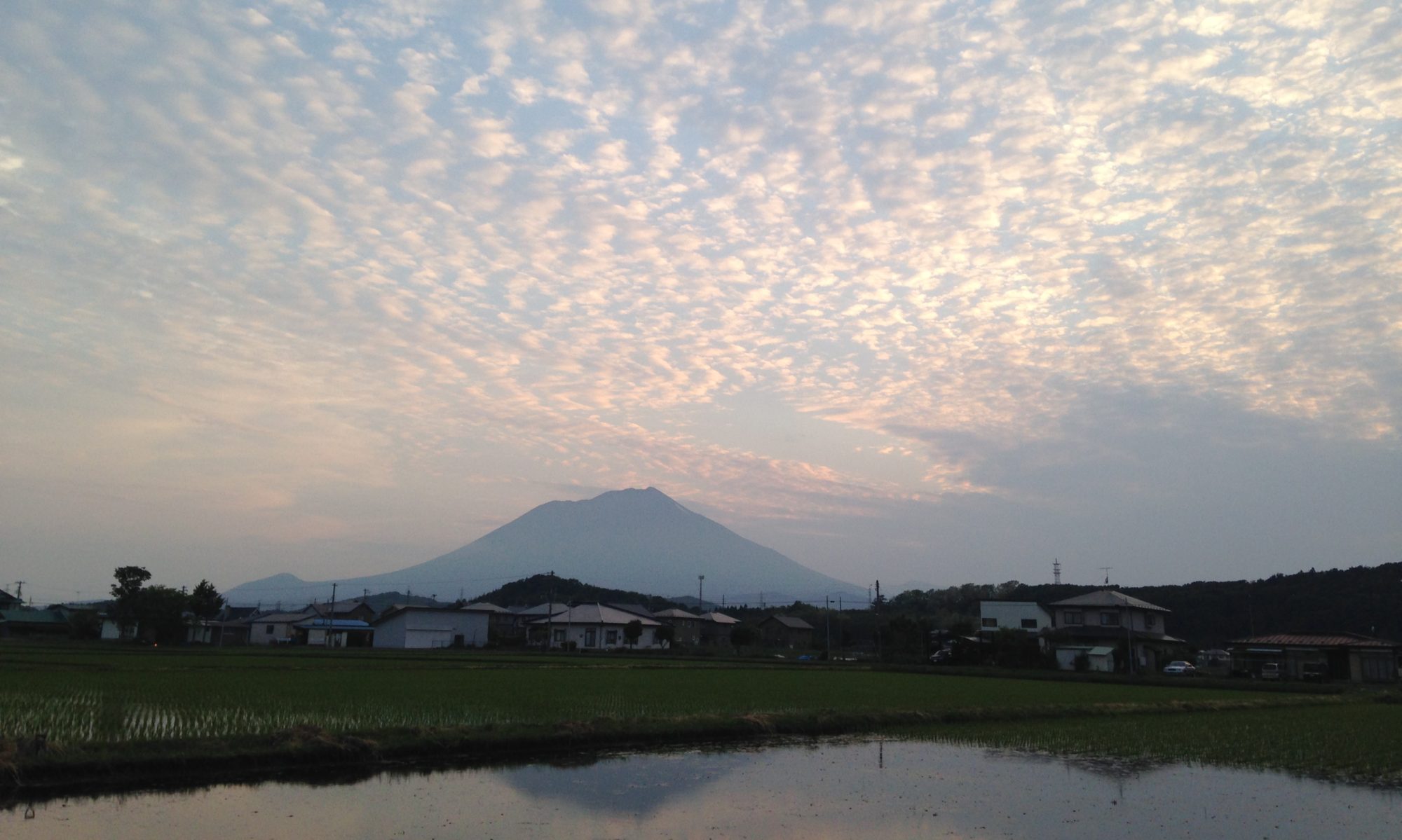
The relatively small shrine, a bit removed from the beaten path, holds three large stones, said to have originated in an eruption of Mt. Iwate.

Mt. Iwate is a large, conical, fairly quiet volcano which commands the horizon of Morioka. In the historical era, the mountain has been very quiet, and if these boulders truly came from an eruption, then it was either in the late 1700s or late 1600s, neither of which, as far as I can find, document any enormous boulders being shot several dozen miles away – indicating that this assertion and foundation of this shrine predates the historical era. The ensuing legend mentions Morioka Castle, which was constructed in the early 1600s, adding further support that these boulders and shrine predate any known eruption of Mt. Iwate within the confines of recorded history. Of course, people have been living in the area for much longer than people have been writing about the area, and when they did write, they did not capture everything nor interpret things in the same manner as is done these days.

While discussing Shinto, kami/gods, and where they come from is beyond the scope of this writing, suffice to say that natural objects capable of astonishing people, whether they are large or “there’s just something about them,” are sometimes considered to be deities, or to house deities. This is the case with Mitsuishi Shrine, the three stones being considered to either be or be home to the deity Mitsuishi.

One of these stones bears the mark of a demon’s hand. Or at least, it used to.

Back when Morioka Castle was a full-on castle and not just the foundation and ruins of a castle, it, like many castles, had a town surrounding it. A demon known in Japanese as Rasetsu (羅刹, a dictionary will state this is the Japanese name for a rakshasa, a human-eating breed of demon of Hindu origin – however, none of the Japanese sources I consulted mentioned this and instead read as though Rasetsu was the name of a demon) was terrorizing the town.

The townspeople prayed to the god Mitsuishi for assistance. The god Mitsuishi then bound Rasetsu to the rocks, and agreed to release the demon on the condition that it never hassle the people again. To seal the deal, the demon left a handprint on one of the boulders. The demon Rasetsu then fled to Mt. Nansho. The ensuing celebration became known as the Sansa Odori festival, which Morioka is known for.

Most accounts of this legend stop here. However, this legend drew my attention first when I studied abroad in Morioka, and returned when I returned to live there after finishing college.

When I studied abroad, I visited this shrine. The third boulder is housed inside a building now to protect it from the elements. I could see the print, but it was weathered and faint enough that I could see it only after being told precisely where to look for it. Like seeing a shape in the clouds.

A few years later, when I lived there, a friend of mine told me that in her youth (she was in her late 30s or maybe early 40s at the time) the print could be clearly seen. As in, it was obvious where to look, and that it was clearly a handprint, a large one at that. In other words, it wasn’t the weathering of hundreds of years that was making the print fade – the fading had occurred not only within her lifetime, but within something like the past fifteen years.

Third installment of Nine Months of Non-Fiction.

The Earth Does Not Belong To Humans

On what authority do humans claim dominion over this planet?

An influential part of the philosophy which politics and laws are built upon (particularly in the United States and similar places) are themselves built upon at least one false premise regarding the nature of property. The nature of conditional logic may lead them to “true” conclusions, as a true premise and false conclusion is the only way which the argument may be considered false, and yet, a false premise with a true conclusion does not make the argument valid (for example, ‘if two is odd, then four is even’).

Take a look at both Hobbes and Locke, commonly thought of as key thinkers in regard to American political thinking. While they may disagree over what the state of nature is, they do seem to agree that in one way or another, the planet was gifted by God to the first humans and thus primarily existing for the sake of humans to use. This is based on what is written in a theological text being used as a historical reference.

The claim simply has not aged well – we know now that Adam, the supposed first human, (to say nothing of this “God” fellow) absolutely did not exist. There was no “first” human, that is not how species evolve, and seeking to find a “first” human mistakes an incremental yet continuous change for one of discrete steps – it is examining the set of all real numbers through the lens of the set of all natural numbers, it misses literally infinite parts. of the process.

Their assumptions of the state of nature do not take into account the way of life and outlook of the planet of the hunter-gather communities, in which humans, in their known entirety, lived in without exception until about 12,000 years ago (the oldest known remains of a modern human is from about 300,000 years old, by the way).

One could read political philosophy and suppose the earth existing for human use is just a decided fact. The proposition that the planet exists explicitly for the purpose of human exploitation is not supported by anything which is not based squarely in mythology.

In other words, the authority of these ideas around the resources of this planet being free-for-taking comes primarily from theology, of which there is no actual proof, leaving the claim with no alternative justification. There is no place for unjustified authority.

If not humans, who does the planet belong to?

Simply put, it doesn’t belong to anyone or anything. Does it have to?

A plot of uncultivated land is not waste. Even considering things purely from the perspective of the impact on the human world, the world of insects and microorganisms is not absolutely distinct from the world of humans. The connection may not be obvious due to the scale of this ranging from things much to small to see with the naked eye to things much to large to directly perceive in their entirety. Trees, for instance, do not exist for the various things humans can make of them – humans and other land animals actually rely on the existence of trees and similar lifeforms to create what we deem a breathable atmosphere. Everyone can agree on that, however, it is the ecosystem of the soil which supports the tree; who knows what else is built upon it? The various ecosystems of the planet are connected, this much is known, how change in one area influences change in another is an observable phenomenon, but the implications of this are unclear.

In any case, seeing the earth as property or as a commodity, is not the only model for society nor is it the only perspective that one can take.

Second installment of Nine Months of Non-Fiction.

Rushmore Retrospective

1998 was not the year of women. The fact that even the negative reviews of Wes Anderson’s Rushmore don’t mention how much of a creep the protagonist is is evidence of this.

Like, have you seen Rushmore lately? Like, any time since, say, 2017 (the year the #metoo movement became widely known seems to indicate the time when American media shifted to considering the radical possibility that women are full-fledged people, complete with all the complexities and complexes that makes someone “normal” )?

My girlfriend and I recently revisited this film. Both in our 30s, we recalled enjoying the film in the past, and settled in for what we thought would be the kind of idiosyncratic, colorful experience which Wes Anderson is known for.

It turns out, the premise of the film is, presumably, a nightmare for many women and a questionable playbook for men.

A woman, in her first year of being a widow, is stalked by a high school kid and his adult friend. That is, more or less, the plot of the film. The men lie, the men modulate their behaviors to try to win her. No one really is held accountable for their behavior.

I don’t think it is such a radical idea that people should not stalk one another. I don’t think it is such a radical idea to be true to yourself rather than to shape your identity to impress those around you. I don’t think it is such a radical idea that people be held accountable for their pathological actions, particularly when they involve harming others.

All that I’m really trying to say here is that the kid in Rushmore is a creep.

First installment of Nine Months of Non-Fiction.

Nine Months of Non-Fiction

I’ve never done much non-fiction writing outside of a school or office setting. I’ll be trying out some different styles over the next nine months (or so), and gathering them all in this post.

Rushmore Retrospective

The Earth Does Not Belong to Humans

The Rock Hand

In Defense of the Unquantifiable

The early 2020’s have already poked a new hole in Federalist No. 10.

The Alarm Bell is Blaring

Speculation of Bad Things to Come

The Strangest Music I’ve Ever Made – The Oiloid Syrup Double Gem Story

The Most Obvious, Most Troubling Story that No One Seems to Acknowledge

And that is that! It took longer than nine months to write these stories, and frankly, I ready for a new experiment. It was fun writing some non-fiction, but the theme of the year was a bit more of a constraint than I enjoyed. Along with everything happening in life (moving, getting a day job, continuing to build pedals, working on my second novel, and getting married), it was difficult to keep to the schedule.

Here’s to what comes next.

dreaming

Part twelve of Twelve Stories.

Hakon and Courtney share a glance and silently decide it has become more than appropriate to begin running, as whatever lies ahead is likely to be, if nothing else, better than drowning, and at the silent thought of drowning, Hakon remembers everything – his silent childhood, his missing patient’s delusions of a coming zombifying plague and his investigation into it which brought him to the mediation retreat with Courtney and Maryl and the others on the beach filled with black crabs, how a blood sample he had no knowledge of how to do anything with and retreating to a cave with Courtney was all he managed to accomplish in his attempt to combat this plague his delusional patient had tried to warn him of, how frail he was in the face of the very zombies he felt he alone was prepared to encounter, and how, in the midst of everything, a storm surge or something filled the cave and he saw images of flowers and ceilings, and the sound of his and Courtney’s wet running feet becomes softer and softer and his field of vision dimmer and dimmer and he feels the cold water deep in his lungs and all around as he finds himself still trapped in the very same storm surge with salt water stinging his eyes and Courtney unseen as he drifts into the sides of the cave which don’t even harbor the slightest pocket of air, unable to control his body and the feeling of pressure and cold finally ends and he feels as though he has just awoken from a decades-long dream, no longer a being bound by flesh and gravity to a long-cursed planet, but true freedom on a level he had never known, feeling awake and for the very first time, ready to begin the day.

Collapsing

Part eleven of Twelve Stories.

The water rises in the tunnel or cave. All along the direction behind their backs, creeping higher and higher, it gets wetter and wetter.

Courtney clasps her hands to her face. Damp and dark, she wonders how it is she can see the water at all. The earthen cavity affords them seemingly endless space to move forward, their little fire long ago consumed by water.

They reach the foundation of what appears to be a fountain. Grasping at gilded golden railings, they now know they are in a tunnel and not a cave.

Hakon’s hands tremble at the infamous insignias coming into sight upon the walls. He wonders if the journey is just beginning. Kicking all Kafkaesque notions aside, limiting logic more morosely, no other notions remained in mind.

Solid concrete reveals itself underneath the sand, and gradually, there is no sand and only concrete and the sound of Hakon and Courtney’s footfalls reflecting off the walls of the concrete shell they traverse, forced unceasingly forward by the rising water, which seems to be gaining speed, their wet shoes adding an audible weight to their steps, all of which making it very simple for anyone to hear them approaching.

An Instant

Part ten of Twelve Stories.

The sediment washes away from the land into the sea. A lone lily once stood upon a cliff here. The cliff is no more, it has become the shore.

An unremarkable cafe once stood upon the sand, and for a brief period, enjoyed the benefits of beach-side property.

But when the water level rose, the sea consumed more land, and the cafe, just as easily forgettable as it was, was easily forgotten. No one came to the beach for the cafe in the first place, and people wondered how they could stay in business, as seaside coffee struck most people as an unpleasant combination of heat and heat.

Sand stretched from the inland desert all the way to the sea now.

What was once grass was now all just sediment. Not one creature walking upon the sand had seen the greenery that once covered the land.

Hakon, in fact, had never even seen a lily.

Hakon is a human, one from a long line of what is called a civilization. Civilizations are what people call their communities over time, sort of. Hakon, like many others, assumed his civilization was the product of ages and ages of development – progress. Attending a meditation retreat on the shoreline of a great desert, it hadn’t occurred to him how the land had changed, how what was once the precipice of a cliff with a perfect lily was now deeply underwater, how many different people had enjoyed the same scenery over the ages, and how a select few had enjoyed it with coffee.

Cliffs had become picturesque beaches, the sand of the beach had met the desertification of the land, pushed back by the relentless rise of seawater, and different civilizations occupied everywhere Hakon had ever been. But Hakon could have never known that things hadn’t always been the way they were.

Hakon sits blank-faced on the soft sand of the tunnel or cave, for the first time considering how he has arrived in this situation with a strange woman who’s name he cannot recall, painfully aware of the feeling of having forgotten something important, questioning if things hadn’t always been that way.

Cafe Ceiling

Part nine of the Twelve Stories series.

Like so many ceilings in the US, the one in this cafe is white. Based on the ceiling alone, you’d have no idea where you were. Like, you’d probably think it was a house, as to who lived in the house, even if you lived there, you couldn’t tell.

You couldn’t do it.

It has those little ridges that oh so many ceilings have. There appears to be some indiscernible pattern in them. The overall pattern is mysterious, but there is some shape which seems to be repeating, although not entirely the same. Kind of like circles, but not a circle with a drawn perimeter, but with the circle’s area made of lines radiating out from the center at random angles.

A circle with a radius equal to one has a circumference of exactly twice the value of pi.

But these, again, aren’t perfect circles adorning this cafe ceiling. If you were to draw a border around each of those bunches of ridges, they would each be vaguely circular, but kind of oblong and irregular.

The ceiling has either been freshly painted, or is completely free of watermarks. Not the kind of watermarks that are used in branding, but the brownish, dirty kind that the word leads ones to believe are caused, somehow, by water. It, the water, has to pass through what could only be described as suspicious roofing (as keeping the elements at bay being one of the precise purposes for bothering to roof oneself), manage it’s way through the ceiling material of any attic space which may or may not lie above, if there is any, and then it, the water, must seep through while simultaneously being halted by the ceiling. Somewhere along the way, the water must become foul and leave a brown stain or something. The appearance of the cafe ceiling does not give any clear indication of the presence of other floors, or if this is the top floor of the building, or if there was some sort of attic, the lighting only revealing that a window or door must be open while eliciting nothing regarding a sense of elevation. No green glow of plant life reaches the ceiling, just the soft white light of an overcast sky or maybe a LED lamp or something. The ceiling is much too well lit for anything less than a tremendous lighting setup, so it’s probably natural lighting. The lighting makes shadows of the ridges of what is maybe paint, but reveals no lines of paint brushes or other tools. This alone, however, is not enough to rule out the possibility of paint covering watermarks on the cafe ceiling.

One could call the ceiling of this cafe unremarkable, in a way.

Lily on the Cliff

Part eight of Twelve Stories.

On a cliff on the western shore stands a lone lily growing in patchy grass. The dirt beneath looks like sand. Perhaps the cliff is made of this sediment, piled up over a span of time much greater than the lily could ever know.

The lily has yellow petals. with reddish speckles, with even more yellow and red coming pouring from the pistil.

Now and then, some sediment falls from the side of the cliff into the sea. The sea is about 85 meters (279 US feet) above the water. Despite the sediment-y composition of the cliff, there is no coast or beach below. The ever growing pile of sediment will get there someday. The lily will have been long gone by then.

The lone lily is frequently visited by bees, when the time is right.

In fact, organisms which can fly are some of the only ones who can even approach the lily. Land-bound creatures over a certain weight know intuitively that the earth of the cliff is too soft to support them.

Something like an ant can visit, though.

Like all lilies, this lone lily is a perennial – each year it comes back to life, blossoms, passes away, and is reborn.

But someday, it’s yearly cycle will come to a permanent, definite end. The cliff is crumbling, slowly, but surely. Someday, there will be no lilies upon any cliffs.

adequate fire a in cave or a tunnel

Part seven of the Twelve Stories series.

Hakon had kindled adequately.

Courtney stopped shivering.

Mesmerized by the flames, she couldn’t help but feel glad.

Hakon didn’t know where they were. His appearance, Courtney’s presence, all implied some continuity from the morning at the mediation retreat on the beach, trying to capture the glimmer of the sea behind his eyes.

But there seemed to be a gap in their memories. They were not underwater, but his memory leaps from sinking into the sea to adequately kindling a small fire in cave, or perhaps it was a tunnel.

“If this is a tunnel,” he thought, “which way did we come from? Did we come from the same direction?”

Courtney could see him knitting his brows. “So, what do we do?” she asks.

“I guess look for an exit. I don’t know which direction we came from.”

“I think you were here when I got here. But I don’t remember which direction I came from, either. How did you start the fire?”

“I have no idea.”

Silt covered the ground of the cave or tunnel. Like a lake or river bed.

“…What was your name, again?” she asks. “I want to say, ‘The Falconer,’ but that can’t be it.”

The quintessence of acquiescence, Hakon sat, green and garbled, consumed by confusion, no longer listening to Courtney.